


Garage door rollers travel only a few feet, but they repeat the journey thousands of times as the door rises, turns, and settles overhead.
They come in different materials, sizes, and bearing designs, and those differences affect noise, maintenance, and service life. This guide explains how rollers work, how to compare them, and when they deserve attention.
How to Tell If Garage Door Rollers Are Bad
Check whether your garage door rollers may need replacement by looking for a wheel that is cracked or chipped, sits tilted on its stem, binds, or produces an unusual noise during movement.
Shaking, jerking, or a roller that repeatedly comes out of the track may also point to roller problems and wear, although similar movement can come from the hinges, tracks, springs, bearings, or opener, as well as an unbalanced or misaligned door.
Do not operate the door if a roller has left the track, the door hangs crooked, a hinge is separating, or a lift cable appears loose. If the door remains level, all rollers are positioned properly in the track, and no related hardware appears damaged, observe one complete cycle from a safe distance. Note whether the rollers produce a repeating sound or irregular movement. Note whether the sound occurs while opening, closing, or both, and record which side and door section it follows.
Keep your hands away from the rollers, tracks, and hinges while the door moves. Do not loosen hinges, top fixtures, tracks, or bottom brackets to test a roller. Bottom brackets are connected to lift cables under spring-generated tension, and loosening door or track hardware can allow the door to shift unexpectedly.
What Do Garage Door Rollers Do?
Garage door rollers guide each door section up the vertical tracks, around the curved sections, and into the horizontal tracks overhead.
Parts of a Garage Door Roller Assembly
The roller consists of several parts and works with surrounding hardware:
- Wheel: Travels inside the track and may be made from plastic, nylon, or steel.
- Hub: The central part of the wheel that houses the bearing or bushing.
- Bearing or bushing: Allows the wheel to rotate around the stem with less friction.
- Stem: Extends from the wheel into the hinge sleeve or roller fixture.
- Hinge sleeve or roller fixture: Holds and positions the roller stem.
- Track: Establishes the path the wheel follows as the door opens and closes.
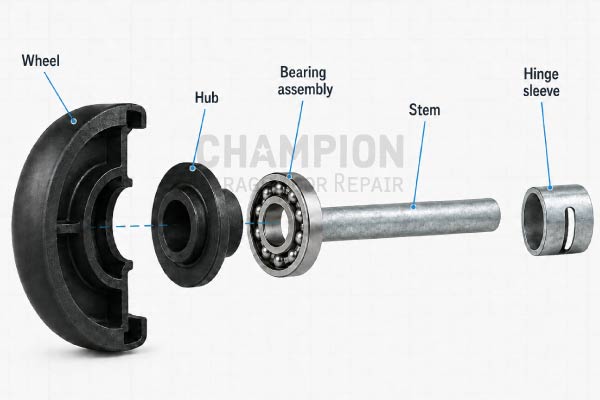
The hinge or fixture and track are not part of the roller itself, but their condition and position directly affect how the roller moves.
Types of Garage Door Rollers
Two rollers can look nearly identical, but the differences that matter are not always visible at first glance. Wheel material affects noise and wear. Inside the wheel, some rollers use a bushing while others use a ball-bearing assembly that may be open, shielded, or sealed. These designs affect friction and maintenance.
Plastic Rollers
Basic plastic rollers often use a bushing instead of ball bearings. They provide an economical option for some residential garage doors but should be watched for cracks, flat spots, deformation, or looseness around the hub.
Plastic rollers with bushings are usually rated for approximately 10,000 cycles, but the rating varies by product. Their actual service life depends on how often the door is used, the condition of the system, and exposure to dirt and moisture. Even with a cycle rating, visible wear is more useful than a general age estimate when deciding whether they need replacement.
Nylon Rollers
Nylon rollers use a nylon wheel attached to a steel stem. The wheel produces less metal-on-metal sound as it travels through the track, making nylon a popular option for attached garages or garages below living spaces.
Nylon rollers are available with bushings, open ball bearings, and shielded or sealed bearing assemblies. Their load and cycle ratings vary, so the material itself does not indicate their service life or compatibility. Check the nylon wheel for cracks, flat spots, or separation around the hub. Clicking or grinding noises can point to wear inside the bearing assembly.
Steel Rollers
Steel garage door rollers use a steel wheel and stem, giving them a durable construction for residential, commercial, and other applications. Their contact with steel tracks generally creates more rolling noise than nylon, particularly when the wheel or bearing assembly begins to wear.
Steel rollers are available with different ball-bearing assemblies, including open and sealed designs. Watch for rust, pitting, worn wheel edges, a bent stem, or excessive movement around the hub. Open bearings may become noisy or resist turning when dirty, dry, or worn.
Open, Shielded, and Sealed Roller Bearings
The way a roller bearing is built and protected varies by the model:
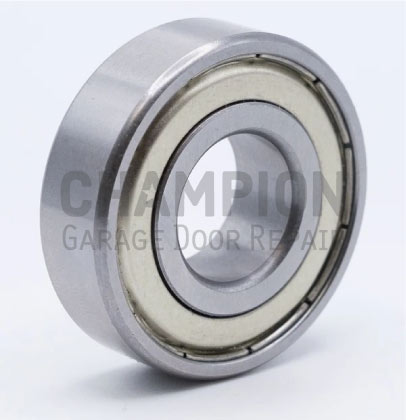
- Open bearings: The bearing balls are exposed, making them more vulnerable to dirt and moisture.
- Shielded bearings: Shields help block larger contaminants while leaving a small clearance around the inner ring. A shield does not provide the same protection as a seal.
- Sealed bearings: Seals provide a stronger barrier against dirt and moisture.
11-Ball, 13-Ball, and Z-Bearing Rollers
An 11-ball or 13-ball roller has one bearing assembly containing that number of bearing balls. The label does not mean the roller contains 11 or 13 separate bearings, and the larger number does not automatically indicate greater load capacity or a longer service life. When comparing rollers, the wheel, bearing construction, seals, stem, and product ratings should also be considered.
In ball-bearing terminology, Z generally refers to a shield on one side of the bearing, while ZZ or 2Z refers to shields on both sides. However, some garage door manufacturers and suppliers use “Z Bearing” as a general product label rather than a precise technical designation. Check the product specifications to confirm the bearing construction.
Specialty and Corrosion-Resistant Rollers
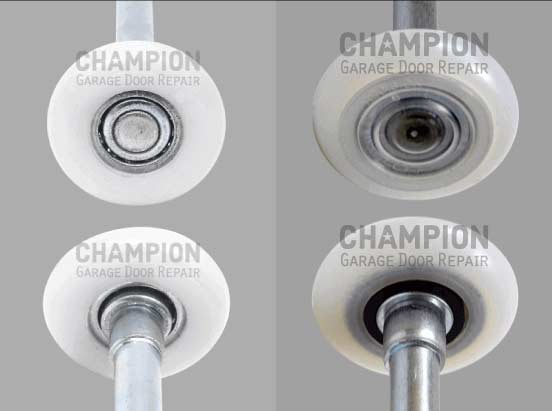
Some nylon and steel rollers are built for frequent use or environments with greater exposure to dust, moisture, and corrosion. They may feature sealed bearing assemblies, protective caps, corrosion-resistant stems, or stainless-steel components to limit contamination or slow corrosion. These features can help maintain roller performance in coastal garages and other demanding environments.
Available in both 4-inch and 7-inch stem sizes, these rollers can operate seamlessly for 15,000 to 20,000 garage door cycles, equivalent to roughly 10-20 years of daily garage door use. Thanks to their nylon-sealed ball bearings, these rollers are known for their durability and reliability.
How to Choose the Right Garage Door Roller
A replacement roller should fit the door specifications, not simply resemble the old part. Compare the following details:
- Door specifications: Check the door label, owner’s manual, manufacturer information, or existing roller part number when available. Some doors use hardware configurations that require a particular roller design.
- Wheel diameter and track compatibility: Garage door roller sizes are usually nominal. For example, a roller sold as two inches has an actual wheel diameter slightly smaller than two inches so it can fit inside a two-inch track. A nominal three-inch roller is not a replacement upgrade for a door built with two-inch tracks.
- Stem length and diameter: The stem should fit the hinge or roller fixture and maintain the intended roller position inside the track. Standard garage doors commonly use single end hinges with rollers sold with 4-inch stems. Some wood, wind-rated, and other heavy-duty garage doors may use double end hinges and longer 7-inch roller stems.
- Load rating: The roller should have a load rating suitable for the door and its hardware configuration.
- Cycle rating: Indicates how many opening-and-closing cycles the roller is rated to complete under specified conditions.
- Wheel and bearing design: Consider noise, maintenance needs, exposure to dirt or moisture, and the manufacturer’s specifications.
Should Garage Door Rollers Be Lubricated?
Lubrication requirements depend on the roller construction. Open ball bearings and some bushings may require a small amount of lubricant at the bearing or bushing, while sealed bearings generally need little or no routine lubrication. Follow the roller or door manufacturer’s instructions when they are available.
Apply lubricant only to the accessible bearing or bushing area. Do not spray the nylon or plastic wheel, coat the inside of the track, or assume that lubrication will correct a cracked wheel, bent stem, worn bearing, or damaged hinge. If cleaning and proper lubrication do not reduce binding or noise, the roller or surrounding hardware should be evaluated.
Should You Replace One Garage Door Roller or the Complete Set?
One damaged roller does not automatically mean every roller needs replacement. Replacing a single roller may be reasonable when the remaining rollers still move properly and show no comparable wear.
Replacing the complete set may make more sense when several rollers are worn, the rollers are similar in age and condition, or the door has a mismatched set of roller materials or bearing designs. A full-set replacement can provide more consistent movement and reduce roller noise when the existing rollers are responsible for it.
The surrounding hardware should be checked before either decision. A bent track, damaged hinge, improper roller spacing, or door misalignment can damage a new roller if the underlying condition remains.
Why Does a Garage Door Roller Keep Coming Out of the Track?
Possible causes include:
- Roller damage or incompatibility: A worn wheel, bent stem, or incorrectly sized roller may not remain properly seated in the track.
- Track damage or misalignment: A bent track or incorrect spacing can pinch the roller, change its angle, or allow the wheel to slip out.
- Loose or damaged hinges: A hinge or roller fixture that has shifted can place the roller at the wrong angle.
- Uneven door movement: A cable or spring problem, an unbalanced door, or poor alignment can allow one side to rise or fall differently from the other, changing the roller’s path.
Even if the garage door appears level and stable, do not continue operating it while a roller is outside the track. The roller, hinge, track alignment and spacing, and overall door movement should be checked before it is used again. Do not force the roller back into place, as this can bend the track or damage the surrounding hardware.
Can You Replace Garage Door Rollers Yourself?
Garage door rollers are held by different hardware depending on where they are mounted. Most rollers are held by end hinges or top fixtures, while the bottom rollers sit in bottom fixtures connected to lift cables under spring-generated tension.
Do not remove bottom brackets, reposition lift cables, unwind springs, loosen cable drums, bend or remove the tracks, or remove several hinges at once. A crooked or off-track door should not be forced into position.
If replacing a roller requires loosening supporting or tensioned hardware, the repair should be handled by a trained garage door technician.
What Should a Technician Check During Roller Replacement?
Roller replacement should address more than the visibly damaged wheel. The technician should check:
- The wheel diameter, stem dimensions, load rating, and compatibility of the replacement roller
- Bent, cracked, or distorted hinges and worn roller sleeves
- Loose or damaged fasteners
- Track damage, spacing, and alignment
- The condition of the cables, drums, top and bottom fixtures
- Door balance and manual movement upon completion of the replacement work
- Opener operation after the door moves properly by hand
The technician should evaluate whether the roller failed independently or was being damaged by another condition. Replacing the roller without addressing the cause may allow the same problem to return.
Garage Door Roller Questions
Are garage door rollers and garage door wheels the same thing?
The terms are often used interchangeably, but the wheel is only one part of the roller. A complete roller also includes the hub, bearing or bushing, and stem.
What counts as one garage door cycle?
One cycle is one complete opening and closing of the garage door.
How many rollers does a garage door have?
The number depends on the door’s height, number of sections, and hardware configuration. Many four-section garage doors have ten rollers, while five-section doors commonly have twelve. Check the door specifications or count the rollers on your existing garage door.
Will new rollers make a garage door quieter?
New rollers can reduce noise caused by worn roller bearings, damaged wheels, or steel wheels moving. They will not fix sounds coming from hinges, springs, tracks, panels, or the garage door opener.


Rollers in a garage door are important because they help the whole system to operate smoothly. My door is always making a large creaking sound when it opens and closes. It would be interesting to learn about the different types of garages that are used.
Having even one thing wrong with your roller door can cause problems with the rest of it. My wife and I have been looking for ways that we can improve my parents’ home, to make it safer and more reliable. I will keep this in mind and start looking for a roller door company that can help us take a look at it.
Our garage door was making a weird noise when opening and closing it. I lubricated the moving parts and noises were completely gone!
I have a wooden residential garage door with 4 inch rollers. Should I replace them with 4 inches or can I go up to 7 inches?
If your wood garage door came with 4-inch rollers from the manufacturer, there is no need to replace them with 7-inch rollers.