


Santa Ana winds are a recurring part of life in Orange County, but their effects on garage doors are often described in vague or exaggerated terms.
Garage doors are among the largest moving components attached to a home. Strong gusts can place pressure on a closed garage door across its wide surface and worsen existing problems involving damaged panels, loose hardware, deteriorated fasteners, unstable tracks, weakened jamb attachments, or other areas affected by wear or damage. The actual risk, however, depends on the wind speed at the property, the size and construction of the door, the condition of the assembly, and whether the opening is subject to unobstructed wind flow.
Building codes use a wind-speed value when calculating how much wind pressure a home and its exterior components, including the garage door, must be designed to resist. For new residential construction in unincorporated Orange County, the code establishes an ultimate design wind speed of 95 mph. That value is used with factors such as building height, terrain, wind exposure, and garage-door size to determine the design-pressure requirements for a given garage-door opening.
The California Residential Code requires garage doors to be tested under positive and negative air pressure that simulates wind acting against and pulling away from the door. Testing under ASTM E330 or ANSI/DASMA 108 evaluates whether the complete door assembly can resist the specified pressure without unacceptable deformation, component disengagement, or structural failure.
Standard garage doors are tested as required by the California Residential Code, even when product specifications may not list the applicable test standard. The topic, however, becomes more confusing when garage door repair companies promote “wind-load-rated” overhead doors or packages without clearly explaining what the term means or whether Orange County homeowners generally need one.
Wind Patterns in Orange County
Orange County is affected by routine coastal airflow and stronger offshore wind events. Wind speed, direction, moisture, and the amount of windblown debris change between coastal communities, inland neighborhoods, foothills, and canyon areas, so the conditions affecting a given garage door can vary by location.
Santa Ana Winds Are Not Orange County’s Coastal Breezes
Not every wind near the coast is a Santa Ana wind. Coastal breezes generally develop when cooler air over the Pacific moves inland toward warmer land. These onshore winds are common near Huntington Beach, Seal Beach, Newport Beach, and Laguna Beach, particularly during the afternoon.
Coastal airflow can bring moisture, salt particles, and sand toward garage-door surfaces and hardware. Continued exposure can contribute to corrosion, finish deterioration, and debris accumulation around the opening and moving parts.
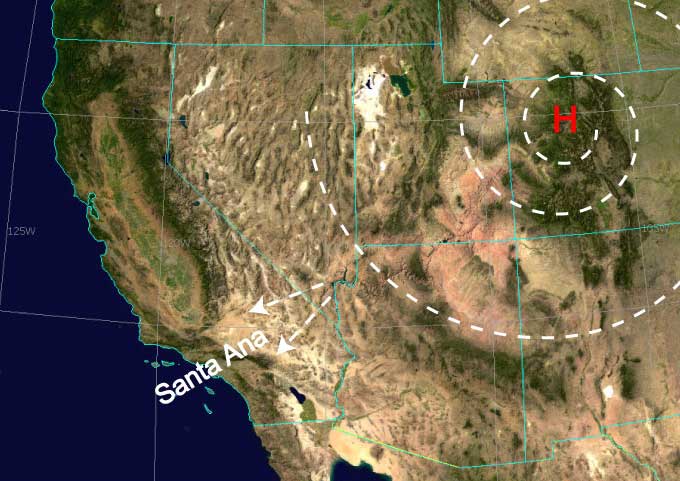
Santa Ana winds are different. The National Weather Service describes them as dry winds that move westward through Southern California mountain passages. Strong events can produce sudden gusts, carry loose debris, and apply pressure to garage doors.
Coastal Winds in Orange County
Routine coastal winds in Orange County are generally lighter than the strongest Santa Ana gusts recorded in mountain and foothill areas. National Weather Service forecasts for Orange County coastal areas may show winds around 10 to 15 mph, with afternoon gusts reaching 25 to 30 mph during some weather patterns.
Stronger coastal wind events can occur. During an offshore wind event in March 2026, the National Weather Service forecast northeast winds of 20 to 30 mph with gusts up to 40 mph for Orange County coastal areas. These stronger winds were associated with that specific offshore event and did not represent normal sea-breeze patterns.
When it comes to garage doors, coastal winds generally create long-term maintenance concerns rather than extreme structural pressure on garage doors.
Santa Ana Wind Speeds
Santa Ana wind strength varies with elevation, terrain, distance from mountain passes, and slope orientation. Foothill, canyon, and mountain stations can record substantially stronger gusts than nearby lowland neighborhoods.
The National Weather Service explains that downslope winds can exceed 40 mph and produce even stronger sudden gusts. Santa Ana winds are a Southern California form of dry downslope flow, and individual events can produce much stronger gusts in foothill and mountain locations.
During a Santa Ana event from October 29 through October 31, 2023, the NOAA Storm Events Database recorded widespread gusts above 35 mph in the Santa Ana Mountains and foothills. Reported peak gusts included 75 mph in Fremont Canyon, 67 mph at Pleasants Peak, 58 mph near Upper Talega, and 57 mph in Trabuco Canyon.
These readings describe conditions in mountain and foothill areas. They do not establish the wind speed experienced by every home in Santa Ana, Irvine, Costa Mesa, Huntington Beach, or another lower-elevation community.
A sustained wind is an average over a defined period, while a gust is a brief increase above that average. Quoting the highest regional gust without identifying the station, terrain, or duration can make a single measurement from a foothill station sound like a countywide residential condition.
Are Santa Ana Winds Comparable to Hurricane Winds?
Santa Ana winds can produce strong gusts, but a brief gust is not equivalent to the sustained wind conditions used to classify a hurricane. The Saffir-Simpson scale classifies hurricanes by maximum sustained wind speed, while Orange County’s 95 mph ultimate design wind speed is a building-code input used to calculate structural loads.
Hurricane-region requirements used in states such as Florida and Texas do not automatically apply in Orange County. Santa Ana winds can still carry debris or worsen existing door damage, but regional gust records do not prove that local homes need a specialized wind-load door or reinforcement package.
What Does Orange County’s 95 mph Wind Design Speed Mean?
Claims that Orange County garage doors must withstand 95 to 110 mph winds oversimplify the code requirements. The residential code does not create a countywide 95-to-110-mph garage-door rating, and coastal cities such as Newport Beach and Laguna Beach do not automatically fall into higher wind-exposure categories.
The California Residential Code assigns wind exposure categories according to the actual conditions at the property. Exposure D applies to flat and unobstructed areas exposed to wind flowing over at least 5,000 feet of open water and only to buildings exposed to wind coming from that unobstructed area.
For unincorporated Orange County, the residential code establishes a 95 mph ultimate design wind speed. That value is used with the property’s exposure category, building height, garage-door size, and other project factors to determine the wind pressure the opening must resist.
Wind speed and wind pressure are related, but they are not interchangeable. Wind speed describes how quickly air is moving. Wind pressure describes the force applied to a building component. Door size, building height, terrain, exposure category, and the opening’s location on the structure can affect the required design pressure. DASMA also explains that site conditions influence wind-load requirements.
A general statement such as “this door withstands 95 mph winds” is therefore incomplete. The code value is part of the building-design process, while the garage door is evaluated through positive and negative structural pressure testing.
How Wind Pressure Acts on a Garage Door
Wind can act on a closed garage door in two directions. Positive pressure pushes the door inward toward the garage. Negative pressure pulls it outward from the opening. Airflow around the building can produce inward pressure, outward suction, or changing pressure during the same event.
A sectional garage door responds as a connected assembly. Loads transfer through the sections, hinges, reinforcement, tracks, brackets, fasteners, and jamb attachments. A weakness in one part of that assembly can affect how surrounding components respond.
A two-car garage door presents a broader surface than a narrower single-car door, but size does not determine the required performance. The building and site conditions still matter.
Wind pressure does not automatically damage a properly installed door. Problems become more likely when sections are cracked or bent, hinges are loose, tracks are unstable, reinforcement is inadequate, or the tracks and jamb attachments do not provide sufficient support.
Realistic Garage-Door Effects of Santa Ana Winds
Strong winds can move unsecured outdoor objects. Branches, trash containers, patio furniture, and other debris carried toward a garage can dent panels, break windows, or interfere with the door’s movement.
The condition of the door influences how it responds. Strong wind may expose or worsen existing panel, track, hinge, or attachment problems even when it did not create the original defect.
Santa Ana winds can also carry dust and smaller debris around the opening. Material that collects near tracks, rollers, hinges, or safety sensors may interfere with smooth travel or prevent an automatic opener from closing when the sensor beam is blocked.
Claims that Santa Ana winds routinely damage torsion springs, opener motors, keypads, or internal electronics should be treated cautiously. Those components are not exposed to direct wind pressure in the same manner as the door sections and exterior attachments. A wind event may contribute indirectly when an impact displaces the tracks or a distorted door overloads the opener, but the actual failure should still be evaluated.
What Homeowners Can Check Before Strong Winds
Homeowners do not need to know the door’s wind rating to check what problems could lead to damage from strong winds. Before a forecast wind event:
- Move trash containers, patio furniture, tools, branches, and other objects away from the garage opening.
- Check for cracked or bent door sections, loose hinges, missing fasteners, unstable tracks, and damaged jamb attachments.
- Confirm that the door closes fully and does not hang crooked, bind, or move unevenly.
- Keep the garage door closed during strong winds and avoid operating it while debris is moving around the opening.
- Do not add reinforcement struts or alter the tracks, hardware, or attachment system without confirming that the changes are compatible with the door.
Contact a licensed garage door company if you are not sure whether the door is secure and safe to operate before or after a strong wind event.
What Makes a Garage Door Wind-Load Rated?
Wind-load testing evaluates the complete door system under inward and outward pressure. The tested assembly includes the door sections, reinforcement, tracks, brackets, fasteners, hardware, and jamb attachments. Changing the door size, window arrangement, track system, reinforcement, or attachment method can change the approved pressure rating.
Common Features of a Wind-Load Garage Door System
Depending on the manufacturer, door model, size, and required design pressure, a tested wind-load system may include:
- Additional horizontal reinforcement struts or C-channels
- Vertical reinforcement posts on some wider doors
- Heavier-gauge tracks
- Additional jamb brackets
- Stronger hinges and rollers
- Reinforced door sections or heavier-gauge steel
- Upgraded springs rated for the increased weight
- Specific fasteners and jamb-attachment details
- Restrictions on door width, height, windows, or hardware
The parts and hardware listed above must be part of the manufacturer-specified assembly. Adding struts, heavier tracks, or other reinforced components to an existing door does not establish a wind-load rating and may add weight that affects the counterbalance system.
Manufacturers may offer reinforced versions of conventional models. Amarr describes a wind-load garage door as an upgraded version of a conventional garage door that has been structurally reinforced to meet applicable building-code requirements. Clopay’s WindCode materials identify specific reinforcement, tracks, hardware, attachment details, and pressure levels for particular configurations.
The exact system varies by model, width, height, window design, track system, hardware, and attachment method. A product name, added strut, heavier hinges, or description such as “Santa Ana wind rated” does not establish that the complete door assembly has been tested and approved for a stated design pressure.
Can a Standard Garage Door Meet Orange County Requirements?
Yes. A garage door does not have to be advertised as hurricane rated, impact resistant, or a specialized high-wind product merely to be installed in Orange County.
A standard garage door may be appropriate for one project, while another opening may require a reinforced system. The answer depends on the building, the opening, and the applicable design requirements, not simply on whether the product is called “standard” or “wind-load rated.” Replacing an existing garage door does not automatically require a hurricane-rated or wind-load system.
Can an Existing Standard Garage Door Be Made Stronger?
Homeowners may choose to strengthen an existing garage door even when a certified wind-load system is not required. Depending on the door’s construction and manufacturer requirements, the work may involve installing reinforcement struts, adding jamb support, using heavier-duty hinges, and upgrading the tracks and rollers.
Structural reinforcement may reduce flex and improve support, but it does not create a tested pressure rating or make the door wind-load certified. Homeowners should also compare the cost of modifying an older door with the cost of replacing it when the sections, tracks, attachments, or counterbalance system are already worn.
The cost depends on the door’s dimensions, construction, existing hardware, and the extent of the proposed work. Reinforcement components add weight, and some doors may require spring or counterbalance-system upgrades to support the additional load. Without an on-site, case-by-case evaluation, a general price range would be speculative and potentially inaccurate.
What to Check Before Buying Garage-Door Reinforcement Upgrades
Before purchasing individual reinforcement components or packages, homeowners should confirm:
- Compatibility: The struts, hinges, tracks, rollers, brackets, and fasteners should be compatible with the existing door system.
- Added weight: Reinforcement can change the door’s total weight and may require spring or counterbalance-system upgrades.
- Door condition: Reinforcing cracked sections, unstable tracks, damaged jambs, or severely worn hardware may not be practical.
- Complete support: Strengthening the door sections without addressing the tracks, jamb attachments, brackets, or fasteners may leave other weak points unchanged.
- Manufacturer requirements: Modifications may affect product warranties or fall outside the manufacturer’s approved configuration.
- Performance claims: Individual upgrades may improve support, but they do not create a tested pressure rating or a certified wind-load system.
Homeowners should request an on-site evaluation before purchasing reinforcement parts. The contractor should explain which components are needed, what additional modifications may be required, and whether reinforcement or full door replacement offers the better value.
Wind-Load and Impact Ratings Are Not the Same
A wind-load-rated door is not automatically impact resistant. Wind-load testing evaluates structural performance under pressure. Impact testing evaluates resistance to windborne debris and cyclic wind pressure.
Orange County’s residential design table identifies no windborne-debris zone. As a result, the code provisions requiring impact protection in designated windborne-debris regions do not create a general local requirement for impact-rated garage doors.
Terms such as “wind rated,” “storm rated,” “hurricane rated,” and “impact rated” are not interchangeable. A reinforced door designed for greater wind pressure may not provide certified debris protection, and impact-resistant glazing does not establish the performance of the complete garage-door assembly.
How Garage-Door Design Pressure Is Determined
The 95 mph ultimate design wind speed does not directly translate into a garage-door model or pressure rating. It is one input used with the property’s exposure category, building height, surrounding terrain, opening dimensions, building geometry, and the door’s position on the structure.
Exposure categories are determined by the terrain, development, obstructions, and open-water conditions surrounding the property. The calculation produces inward and outward design-pressure requirements expressed in pounds per square foot, or PSF. The proposed garage-door configuration must meet the pressure established for the opening.
For example, two homes may use the same 95 mph design wind speed and have the same 16-by-7-foot garage-door opening, yet require different design pressures because their exposure to wind, roof height, building configuration, or surrounding terrain differs.
Why Garage-Door Ratings Use PSF Instead of MPH
Miles per hour measures wind speed. Garage-door design pressure, expressed in pounds per square foot, is the site-specific pressure the door must be rated to resist. Manufacturers use design-pressure ratings because the same wind speed can produce different loads depending on the opening and building conditions.
A statement that a door is “rated for 95 mph” is incomplete unless it corresponds to the required design pressure and exact tested door configuration.
How to Evaluate a Wind-Load Recommendation
A door’s appearance does not establish its wind resistance, tested pressure rating, or code compliance. A recommendation for a specialized wind-load garage door should be based on more than the property’s city or distance from the coast. Homeowners should ask:
- What wind-exposure category applies to this property?
- What design pressure is required for the garage-door opening?
- What property, plan, or code provision establishes that design pressure?
- Does the proposed door configuration meet the required positive and negative pressures?
- Is impact resistance actually required, or is the recommendation limited to structural wind pressure?
A coastal address does not automatically establish Exposure D, and a canyon location does not create a separate garage-door wind-speed rating. The 95 mph code value is not a universal product rating, and reinforcement does not establish that a door has been tested for a stated design pressure.
When Is a Specialized Wind-Load Door Necessary in Orange County?
Specialized wind-load garage doors are generally not required in Orange County. A wind-load system may be necessary when plans approved for the project specify a particular design pressure, or the building department requires the garage-door opening to meet a project-specific wind-load requirement.
A contractor recommending a wind-load system or upgrade should provide the required pressure rating and explain the specific plan, property, or code requirement supporting the recommendation. The Clopay Residential WindCode Calculator illustrates how building dimensions, opening size, roof height, exposure to wind, and the door’s location on the structure can affect the recommended pressure rating.
Homeowners who are unsure whether a specialized wind-load door is required should contact the building department for the city or county where the property is located or, for unincorporated properties, OC Development Services.
If a design pressure is not already stated in the approved plans or established through the applicable code provisions, and the building department requires a site-specific engineering calculation, a licensed civil or structural engineer should determine the required pressure. The garage door contractor should then supply and install a door system that meets that requirement.


