


When the garage door opens at the press of a button, the opener gets the credit, but the torsion springs do most of the heavy lifting. By generating torque that counterbalances the door’s weight, they allow the door to open and close in a controlled manner, whether it is moved by hand or by an opener.
That carefully balanced arrangement can become obvious the moment a spring breaks. The door may become difficult to operate, an automatic opener may stop or behave unexpectedly, and related parts can lose tension or sustain damage.
If the spring has already broken, start with the warning-sign table and the guidance for an open door or trapped vehicle. For replacement questions, continue to the sections on spring life, sizing, spring configurations, and cost.
What Are Garage Door Torsion Springs and What Do They Do?
Garage door torsion springs are helical steel springs used in the door’s counterbalance system. The springs are wound a calculated number of turns to produce the torque required to counterbalance that door’s weight.
As the garage door opens, the springs begin to unwind, releasing stored torque that rotates the torsion tube and cable drums. The lift cables wind around the rotating drums, pulling upward on the bottom brackets and helping raise the door along its tracks. As the door closes, the cables unwind from the drums and rotate the torsion tube in the opposite direction while rewinding the springs.
As more door sections move onto the horizontal tracks, the tracks carry a larger share of the load. The springs unwind and provide less torque at the same time, helping keep the door balanced throughout its travel.
Where Are Garage Door Torsion Springs Located?
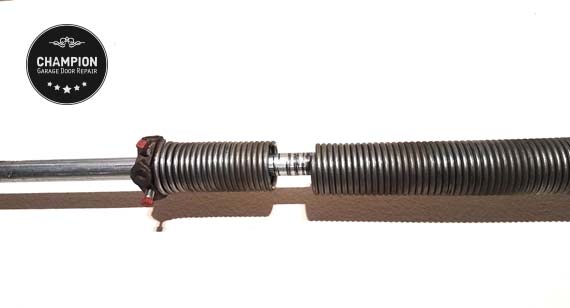
Most torsion springs are mounted on a torsion tube directly above the garage door. On a standard torsion system, one or more springs remain visible near the center of the tube, with a cable drum positioned at each end. The stationary cone fastens the spring to the center bracket, while the winding cone is secured to the torsion tube with set screws.
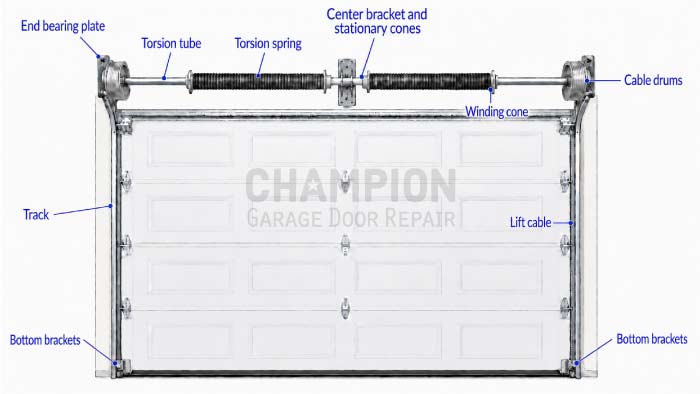
Some low-headroom configurations use a rear-mounted torsion system. Instead of sitting above the opening, the springs and shaft are installed farther inside the garage, near the ends of the horizontal tracks.
Wayne Dalton’s TorqueMaster system encloses its springs inside a metal tube, so the coils are not visible. Enclosed torsion systems still use torque to counterbalance the door, but their design, hardware, and replacement requirements can differ from those of a standard torsion system.
Torsion springs should not be confused with extension springs, which stretch and contract.
How Can You Tell If a Garage Door Torsion Spring Is Broken?
On a standard torsion system, a visible separation in the spring coil is the clearest sign of a break. The coil that once formed a continuous spring will be divided by a noticeable gap. The gap will not be visible on an enclosed TorqueMaster system.
A spring can also break with a sudden bang as the stored torque is released. Afterward, the door may no longer open or close as expected. Here are the most common signs that your spring may be broken and what to do about it:
| What you observe | What it can mean | What to do |
| A visible separation in an exposed torsion spring | Strong visual evidence that the spring has broken | Stop operating the door and arrange repair |
| A loud bang or snapping sound from the garage | A spring may have broken and released its stored torque | Look from a safe distance for a separated coil. In an enclosed system, the broken spring may not be visible. |
| The door will not open, feels unusually heavy, or rises only a few inches | The spring may be broken or providing too little counterbalance | Stop repeated attempts and do not force the door open |
| The garage door will not close automatically, or the opener stops or reverses | The opener may be responding to abnormal movement caused by a broken spring or another problem | Stop repeated attempts and note where the door stops or reverses |
| The top section bends or buckles while the opener pulls | A broken spring may be causing the opener to pull against too much door weight | Release the control immediately and do not try again |
| A cable appears slack or comes off its drum, or the door hangs crooked | A broken spring, cable displacement, or drum problem may have reduced cable tension | Stop operating the door and leave the cables untouched |
| The door jerks, binds, moves unevenly, or produces unusual sounds | A spring or another mechanical component may be interfering with movement | Do not force the door; have the cause evaluated |
| The door closes too quickly, drops, or will not remain open | The spring system may not be providing enough counterbalance | Keep clear and stop operating the door |
| The spring shows rust, cracking, distortion, or other visible damage | The spring may be deteriorated, although damage does not always mean it has broken | Record the condition and have the spring evaluated |
| One spring is visibly broken, but the door still moves | On a system with two or more springs, other springs may still support part of the door’s weight and allow the door to move | Stop using the door and arrange repair |
What If the Door Is Open or a Vehicle Is Trapped?
If the Garage Door Is Open or Partly Open
If a torsion spring breaks while the garage door is open or partly open, the door may not have enough counterbalance to remain stable. Keep everyone away from the opening, and do not pull the emergency-release cord or attempt to lower, lift, or straighten the door. Tell the garage door repair company that the door is stuck open or partly open and whether it appears level, crooked, or off its tracks so the technician can arrive prepared.
If a Vehicle Is Trapped Behind the Door
If a vehicle is trapped behind a garage door with a broken spring, tell the repair company when scheduling the call and ask whether urgent service is available. Do not force the door open with the opener. Without adequate spring assistance, the opener may become overloaded or damage the top section. Lifting the door with several people is also unsafe because it may be far heavier than expected, the cables may be displaced, and the group could lose control of it. If the vehicle is needed for an immediate emergency, arrange other transportation or contact emergency services rather than forcing an unstable door open.
Why Do Garage Door Torsion Springs Break?
Garage door torsion springs commonly break from metal fatigue caused by repeated use. Each time the door opens and closes, the springs unwind and rewind, placing stress on the spring wire. That repeated loading forms tiny cracks that grow until the spring breaks. Other conditions can accelerate spring fatigue by creating weak points in the wire or increasing the stress placed on it.
Corrosion and Surface Damage
Moisture can corrode the spring wire and leave pits that concentrate stress. Salt in coastal air can accelerate corrosion. Deep scratches and other surface damage can create similar stress points.
Incorrect Spring Size or Winding
A spring that is incorrectly sized for the door or overwound may operate under excessive stress and reach fatigue failure sooner. Adding windows, insulation, overlays, reinforcement, or other components increases the door’s weight and changes the required counterbalance. Adding more turns to an unsuitable spring does not make it proper for the heavier door and may increase spring stress further.
How Long Do Garage Door Torsion Springs Last?
Garage door torsion-spring life is measured in operating cycles rather than years. One cycle consists of the door opening and then closing completely. A spring rated for 10,000 cycles will reach that number much sooner on a door used five times per day than on one used twice.
How to Estimate Torsion-Spring Lifespan
Estimated years = spring’s cycle rating ÷ average daily cycles ÷ 365
| Spring cycle rating | 2 cycles per day | 3 cycles per day | 5 cycles per day |
| 10,000 | About 13.7 years | About 9.1 years | About 5.5 years |
| 15,000 | About 20.5 years | About 13.7 years | About 8.2 years |
| 20,000 | About 27.4 years | About 18.3 years | About 11 years |
| 30,000 | About 41.1 years | About 27.4 years | About 16.4 years |
The table above approximates how long it takes to reach a spring’s rated cycle life based on how many times the door opens and closes each day. Corrosion, surface damage, improper installation, and changes to the door’s weight can shorten its actual service life.
How Is the Correct Garage Door Torsion Spring Determined?
Technicians determine the correct torsion spring by calculating the torque and spring rate the door requires, then usTechnicians determine the correct torsion spring by calculating the torque and spring rate the door requires, then using spring-engineering tables to find the spring specifications that produce those values.
The turning force the springs must provide to begin lifting a standard-lift garage door is estimated as:
Required shaft torque ≈ door weight × cable-drum radius
The full calculation uses the door’s actual weight and height, track radius and lift configuration, cable-drum model, available spring space, number of springs, and intended cycle life.
Within its designed operating range, each additional turn increases the spring’s torque at a predictable rate. This spring rate is measured in inch-pounds per turn (IPPT). Spring-engineering tables then identify the wire diameter, inside diameter, and length needed to provide that rate.
How Garage Door Torsion Springs Are Measured
When the garage door has operated properly and has not been modified, the existing spring measurements usually provide the quickest starting point. The three principal physical measurements are:
- Wire diameter: The thickness of the wire used to form the spring coils.
- Inside diameter: The distance across the inside of the spring coil.
- Coil length: The length of the coil body from end to end, excluding the cones. Spring length is measured when the spring is fully unwound because winding changes its length.
Torsion springs also have a wind direction and cone type:
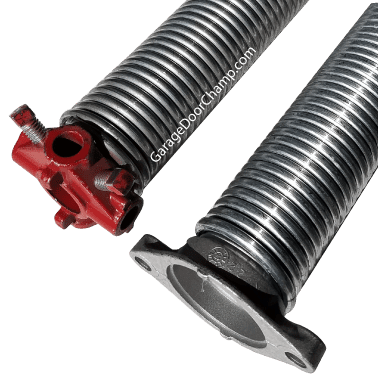
- Wind direction: A spring is either right-hand wound (RW) or left-hand wound (LW). Standard winding cones often use red for RW springs and black for LW springs. Because the color may be faded, missing, or nonstandard, the direction of the spring wire should also be confirmed.
- Cone type: The stationary and winding cones must be compatible with the spring and torsion-system configuration. Universal or specialty cones may not follow the standard red-and-black convention.
Door construction, steel thickness, windows, insulation type and thickness, the insulation materials that produce its R-value, decorative overlays, reinforcement struts, and other additions affect the door’s weight. For example, two 16-by-7-foot steel doors can require different spring configurations when their steel gauge, insulation construction, windows, or reinforcement differ.
A fresh spring calculation is needed when the door has gained weight or its previous balance was incorrect.
Can You Install a Stronger Garage Door Torsion Spring?
A torsion spring should not be replaced with a “stronger” spring simply to gain more lifting power. The spring system must provide the correct torque for the door throughout its travel.
Too much torque can cause the door to rise on its own or resist closing. Too little torque leaves the door heavy, makes it harder to open, and can cause it to descend too quickly. An incompatible spring configuration can also leave the lift cables with insufficient tension during part of the door’s travel, allowing a cable to loosen or come off the drum.
A stronger spring does not automatically last longer. High-cycle torsion springs can provide the torque needed to balance the door and are designed to complete more opening-and-closing cycles than a standard spring. These springs typically use thicker wire and a longer coil, although the available space on the torsion tube can limit the options.
A technician can replace an existing spring with one that has a different wire diameter, inside diameter, or length, or convert a single-spring system to use multiple springs, provided the new configuration keeps the door properly balanced, has sufficient winding capacity, and is compatible with the available space and hardware.
What Is the Difference Between Oil-Tempered, Galvanized, and Powder-Coated Springs?
Oil-tempered springs are made from heat-treated spring wire and usually have a dark, slightly oily surface. The oil-tempering process produces wire with high tensile strength and resistance to permanent deformation under load. Long before modern torsion springs, metalworkers forged blades and heat-treated the steel to give it strength without making it brittle.
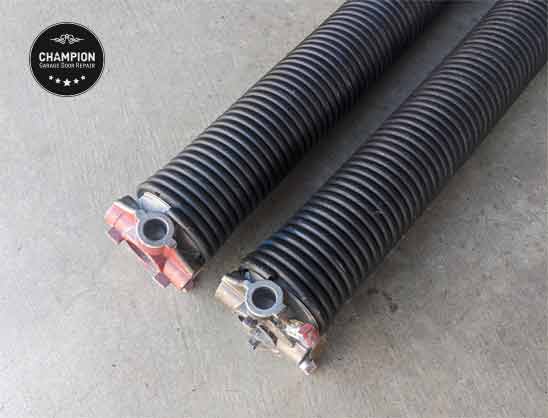
Galvanized springs use zinc-coated wire, which helps resist surface corrosion and gives the spring a cleaner, brighter appearance. The zinc corrodes before the underlying steel, helping limit rust damage where a small scratch breaks through the coating.
Powder-coated springs have an added finish that helps protect the wire from moisture and corrosion. The coating can be applied to oil-tempered spring wire, so a spring can be both oil-tempered and powder-coated.
The spring’s type and finish are only part of what affects its service life. Its dimensions, operating stress, installation, frequency of use, and environment also matter.
Should a Garage Door Have One Torsion Spring or Two?
Either configuration can be correct. Some garage doors can be properly balanced with one torsion spring, while others need two or more. The number of springs required depends on the combined torque needed to counterbalance the door, the available space on the torsion tube, and the spring dimensions.
A single-spring system is not automatically inferior, and two springs do not automatically provide a higher cycle life. Our guide, Should Your Garage Door Have One or Two Springs?, explains the differences, benefits, and tradeoffs of single- and two-spring systems.
Should Both Torsion Springs Be Replaced When One Breaks?
Replacing both springs is often recommended when they were installed together as a matched pair. Both springs have completed approximately the same number of cycles, so the unbroken spring may also be approaching the end of its expected cycle life. Replacing the pair also maintains the intended spring configuration.
Replacing both during the same visit can help avoid another repair appointment if the remaining spring fails later, along with problems such as a door that will not open or a vehicle trapped inside.
Replacing both springs is not always necessary. The remaining spring may be newer, may have been installed separately, or may have different specifications as part of the original system design.
What Should a Torsion-Spring Replacement Include?
The scope of a spring replacement varies by company and the work included in the estimate. The core work involves confirming the correct replacement spring specifications, removing the existing spring, installing and winding the new spring or spring set, checking that the lift cables are seated correctly on the drums, and testing the door’s balance and movement after installation. Related hardware checks, opener testing, lubrication, disposal of the old springs, and adjustments to other parts may be included, quoted separately, or excluded.
What Maintenance Do Garage Door Torsion Springs Need?
Torsion springs require little routine maintenance. A light coating of garage-door lubricant may help if the coils are dry, noisy, or exposed to moisture, but not every spring requires lubrication on a fixed schedule. The spring will still accumulate metal fatigue with use, even when lubricated.
A basic garage door balance test can show whether the springs are supporting the door properly. When the door appears intact and operates normally, close it completely, disconnect it from the opener, and slowly lift it by hand to about halfway. A balanced door should remain near that position. If it rises or falls noticeably, lower it carefully and have the spring system evaluated.
Stiff bearings, worn rollers, bent tracks, or damaged door sections can make the door bind or move unevenly. These problems may resemble improper balance, but the cause is different.
Testing the door’s balance does not involve adjusting the springs. Tightening, unwinding, rewinding, or repositioning a torsion spring requires the proper tools and training. A trained and certified technician can determine whether the springs need adjustment or replacement, correct the door’s balance, and check the related hardware.
Garage Door Torsion Spring FAQs
Can a Broken Torsion Spring Be Repaired?
A broken torsion spring is replaced rather than welded or joined back together. Once the spring wire fractures, the spring can no longer counterbalance the door.
Does a Broken Spring Mean the Entire Garage Door Must Be Replaced?
Usually not. If the door sections, tracks, cables, and other hardware remain serviceable, the repair can be limited to the spring system. Damage or deterioration elsewhere in the door should be evaluated separately.
Is a Spring’s Cycle Rating the Same as Its Warranty?
No. The cycle rating estimates how many opening-and-closing cycles the spring is designed to complete. The warranty determines what is covered, for how long, and under which conditions. A spring with a higher cycle rating does not automatically come with longer warranty coverage.
What Affects the Cost of Torsion-Spring Replacement?
The cost depends on the number and specifications of the springs, the door and torsion-system configuration, accessibility, related hardware, and the work required to complete the repair.
| Replacement category | Estimated cost | Common configuration |
| Standard replacement | $350–$800 | Standard-lift steel door, accessible front-mounted torsion system, commonly available spring specifications, and no related damage |
| Heavier or upgraded system | $600–$1,200 | Insulated or double-wide door, multiple springs, high-cycle springs, or higher-capacity components |
| Custom or complex system | $900–$1,500+ | Wood, overlay, oversize, rear-torsion, low-headroom or high-lift door, limited access, or custom springs |
The estimated costs include the replacement spring or spring set and installation labor for one garage door. System conversions, additional repairs, and unrelated replacement parts are priced separately.
How Long Does Torsion-Spring Replacement Take?
A standard torsion spring replacement often takes about an hour once work begins. Rear-mounted or enclosed systems, custom springs, limited access, conversions, or complex repairs can take longer.
Garage Door Spring Repair in Orange County
If your spring has broken or the door is no longer properly balanced, Champion Garage Door Repair provides garage door spring repair throughout Orange County. A technician can evaluate the system, determine what’s needed, and explain the available springs and applicable warranty coverage.


You gave really good safety tips about what to do to make sure that you don’t get hurt if the garage door springs break. My garage door has been jerky when I open and close it and think that the springs might be close to breaking. I’ll have to call a garage door repair company out to look at my door and see if it is the springs or not.
Disconnecting the garage door when the spring may be broken could be a bad idea. Our garage door is stuck ajar and my husband thinks it’s best to try and fix it when he gets home, which I think is a bad idea. I’ll opt to call a garage door repair service to have ours looked at and serviced. That way I can hopefully get my car out of the garage by tomorrow so that I won’t have to call a cab to work again.
I’ve been thinking about getting a garage door torsion spring repair service soon because I’ve been troubleshooting mine for some time now. I think it’s safe to assume that it’s faulty springs that make my garage door slam shut instead of slowly closing.
Damaged garage door spring can affect your door’s efficiency
Can a torsion spring be moved from the front of door to rear because of clearance issues
Hello Samuel. Yes, the torsion assembly can be installed at the back end of the garage (end of the garage door’s horizontal tracks).
hey friends.
I want to replace a double torsion spring for a garage door, bellow the information,
what kind of torsion spring should I need to buy?
thanks for your assistance really appreciate. Fabian
Brand Door : Wayne Dalton
Year: (approx. 2000)
Made from Steal, and 2 torsion spring.
Door Heights: 11ft
Door size: 122 inches Wide
Section QTY: 6 ( 24’’x24’’x24’’x21’’x21’’x21’’)
Weight: 290 pounds
Former Length torsion spring: 44’’ ½
Wire size: 2’’ 1/2 : (for 10 coil count) :
Inside spring size :2’’ diameter
Hello Fabian, you should always replace the garage door spring with the OEM spring that came with the door unless you have the knowledge to convert it to a spring that produces the same torque output. If you’d like us to do that for you please provide us with:
1. The spring’s length when it’s in equilibrium state.
2. The spring’s coil inner diameter.
3. The spring’s gauge.
I have a technical question for you. I purchased a standard 8 ft Garage door and cut 2 ft off of each panel to make it fit a 6 ft opening in a shed. The door is installed and when I tension the spring it is either too much tension and the door springs up and wont stay shut or when there’s not enough tension it unspools the cable off the drum when the doors is raised. Im thinking if I shorten the spring I can solve the problem. Or does it just need some real fine tuning. Any ideas?
Hello Kevin, shortening the spring will cause it to generate a greater torque output. You took off weight from your garage door by removing part of the sections, therefore, you’ll need to replace the spring with a spring that support a lighter door (if fine tuning them doesn’t help). If you can provide us with the door’s weight, size, and track’s radius, we’ll be able to tell you what spring you need.
Good Morning: We had our double torsion springs replaced on Monday. On Friday morning when opening the electronic door, the bracket arm of the opener completely separated from the door, bolts and all. Might we have set the spring too tight, or not enough? The fact this happened within a couple days of replacing the springs makes me think it is the setting of the spring.
Hello L Patterson, it’s possible that the setting of the spring causing the issue. You’d want to test the garage door balance first. If the door is too heavy or pulling up, you’d want to have that fixed. Note that a minor deviation shouldn’t be a concern.
Good afternoon,
I’m fixing to add insulation to my garage door and it will make it heavier can i tune the existing springs for that extra weight or should i replace the springs.
Tom
Hello Tom,
First, you can attempt to recalibrate the existing springs to properly support the door’s weight. If the door remains unbalanced after this adjustment, it’s advisable to replace the springs. Learn how to check the garage door balance here.
We are in a rural area and unable to get an installer. I am handy and can install but cannot find a resource to tell me what spring to order (what colour for weight) . My door Iweighs 220 pounds is a wooden door, and size 10 * 10, i was unable to find a 10*10 door regionally so i combined two 10*7 doors, shortening one to make the 10 ft height. Can you tell me how to determine the correct spring size to order? Thanks in advance!
Hello Willie, to determine the required springs, we’ll also need information about the track radius and the drums being used.