


If your garage door remote only works at close range or has stopped responding, a weak battery is one of the first things to check.
Replacing it is usually simple. You’ll need to open the case, find the right battery, install it according to the polarity markings, and test the remote afterward.
The exact steps vary by model, but changing the battery usually doesn’t require reprogramming it to the garage door opener.
How to Replace Your Garage Door Remote Battery
Step 1: Open the Remote’s Battery Cover
Garage door remotes don’t all open the same way. Check the back and edges of your remote to see how to open it.
- Pry-open case: The most common type we see. Look for a small notch or slot along the case seam. Depending on the model, you can use a flathead screwdriver, coin, or visor clip to open the case. Insert the tool into the notch or slot and gently twist it to release the case.
- Screw-secured case: Remove or loosen the screws with the proper screwdriver before opening the housing.
- Slide-off cover: Use your thumb to slide the battery cover off in the direction indicated, if marked.
Some remotes require you to remove the visor clip or key ring first. If the case doesn’t open easily, don’t force it. Check the manufacturer’s instructions for your remote model so you don’t damage the case or the parts inside.
On pry-open and screw-secured remotes, the case typically separates into two halves. The top half contains the buttons and their cover, while the bottom half holds the transmitter board and battery.
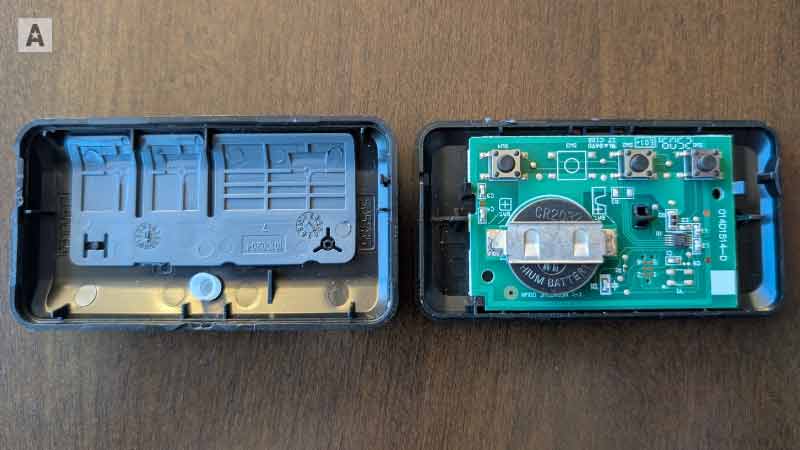
Step 2: Identify the Battery and Find the Correct Replacement
Before removing the old battery, check which way it’s facing and look for the battery code printed on it. You can also take a quick photo to help you remember its position.
Many modern garage door remotes use a CR2032 battery, usually installed with the positive (+) side facing up. However, the battery type and orientation can vary by make and model.
Other batteries used in garage door remotes include CR2016, CR2025, and A23. Make sure the replacement matches the battery type specified for your remote or is a verified equivalent. Batteries with the same size or voltage aren’t always interchangeable. For example, CR2016 and CR2032 batteries are both 3V and have the same diameter, but the CR2032 is thicker.
Some remotes also use more than one battery. For example, the LiftMaster 74LM uses two CR2032 batteries. If the old battery is missing or you can’t read the code, use your remote’s model number to find the correct battery in the manufacturer’s instructions.
Step 3: Install the New Battery
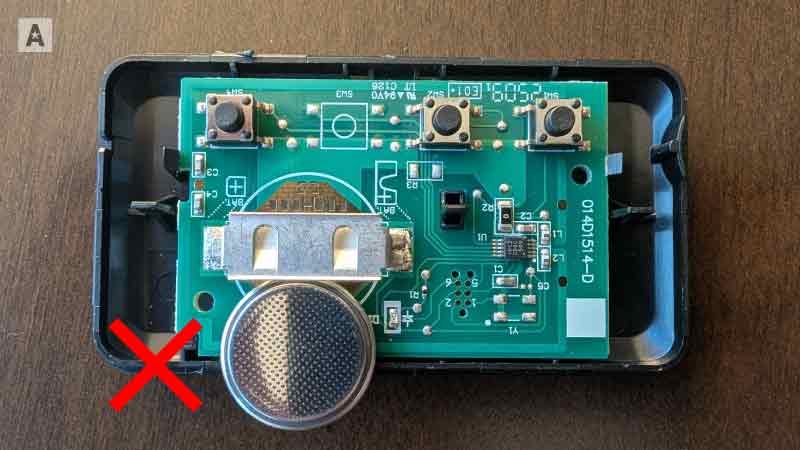
Place the new battery into the compartment, making sure the positive (+) and negative (−) sides line up with the polarity markings. If you took a photo earlier, use it as a reference.
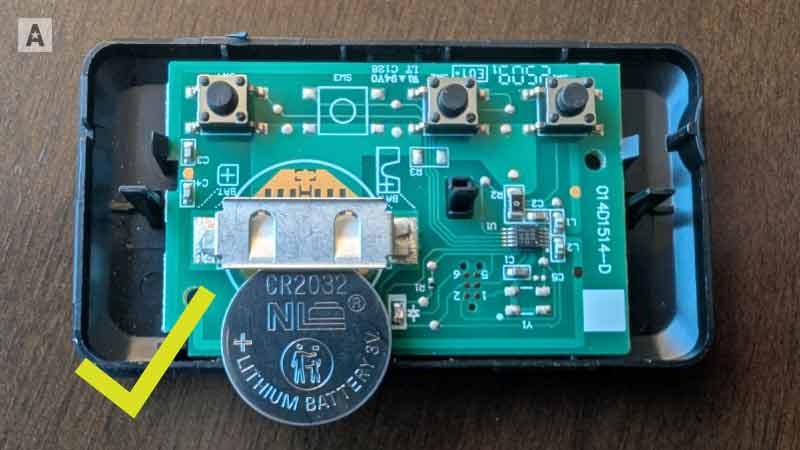
Make sure the battery fits securely in its holder. If you notice corrosion, bent contacts, or other damage inside the compartment, don’t force the battery into place. If your remote uses more than one battery, make sure each one is positioned correctly.
Safety tip: Keep new and used coin batteries away from children. Swallowing one can cause serious internal injuries and requires immediate medical attention.
Step 4: Close the Remote and Test It
Put the battery cover back in place and reinstall any screws or clips you removed. Make sure the case is securely closed.
Make sure you can see the garage door and that the doorway is clear before pressing the remote to test it. If the remote previously worked only at close range, try it from farther away to see if the range has improved.
Take the old battery to a designated battery collection or recycling site. For coin batteries, cover the terminals with nonconductive tape before disposal. Don’t throw it in your household trash.
Common Mistakes When Replacing a Garage Door Remote Battery
Even a simple battery replacement can come with a few challenges. Here are four common issues our technicians have helped resolve:
- Damaging the case while opening it: Prying at the wrong spot or using too much force can break the plastic clips or crack the case.
- Buying the wrong battery: Batteries that look nearly identical may have different thicknesses or other specifications. The wrong battery may not fit properly or make good contact with the holder.
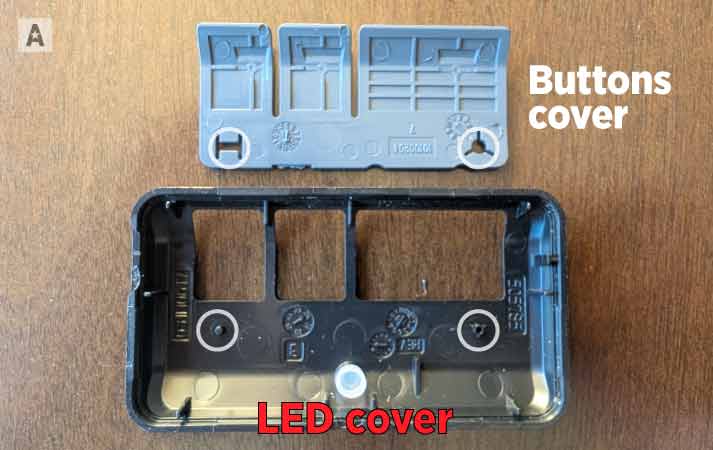
- Misplacing buttons and LED covers: On many remotes, the buttons and LED covers are not permanently secured in place and may shift when the case is opened. Before closing the remote, make sure these parts are properly positioned. If the two halves don’t fit together, check their placement and adjust them as needed. Don’t force the case closed or tighten the screws until everything fits correctly.
- Accidentally changing opener settings: Trying to reprogram a remote after replacing its battery can cause additional problems. Holding down the Learn button too long can erase the opener’s stored codes for remotes, keypads, and vehicles with built-in garage door controls. Pressing the wrong buttons on some openers can also change the door’s travel limits, preventing the opener from operating properly.
How to Tell If Your Garage Door Remote Battery Is Low
If your remote’s battery is weak, you may notice one or more of these signs:
- Reduced range: The remote only works when you’re close to the garage, not from your usual distance.
- Intermittent operation: The garage door doesn’t respond every time you press the remote button.
- Dim or unlit indicator: If your remote has an LED light, it may be dimmer than usual or not light up at all when you press a button.
These signs don’t always mean the battery is low. Radio interference, worn buttons, a faulty remote transmitter, or a problem with the garage door opener can cause similar behavior.
New Battery, but the Remote Still Doesn’t Work?
If your remote still isn’t working after replacing the battery, double-check that you’re using the right battery, that it’s installed in the correct direction, and that it sits securely in the holder.
If everything looks correct, how the remote responds can help you figure out what to check next.
| What Happens | What to Check Next |
| The remote’s LED doesn’t light up | The battery may not be making proper contact. Check for visible corrosion or damaged contacts. The remote itself could also be faulty. |
| The LED lights up, but the door doesn’t respond | Try another remote, if available. If it works, the first remote may have a programming or transmitter problem. |
| The remote only works at close range | Radio interference or a problem with the remote or opener’s receiver could be affecting its range. |
| The remote opens the door but won’t close it | The remote is communicating with the opener. Check for an obstruction or a problem with the safety sensors before attempting to reprogram it. |
| The wall control works, but none of the remotes do | If your opener has a lock or vacation mode, check whether it’s turned on. If not, possible causes include lost programming, radio interference, or a problem with the opener’s receiver. |
Does the Remote Need to Be Reprogrammed?
Replacing the battery normally doesn’t erase the remote’s programming. However, if the opener’s memory was cleared or the remote was never paired, you may need to program it again. The procedure varies by model, so follow the manufacturer’s instructions.
Still Having Problems With Your Garage Door Remote?
If replacing the battery didn’t help, our garage door remote troubleshooting guide covers other things you can check.
If you need professional help in Orange County and South LA, Champion Garage Door Repair can inspect the remote, opener, and garage door to find out what’s wrong.
Our technicians will explain what needs to be repaired, how much it will cost, and what the work involves.
Contact us or call today to schedule a service visit and get the problem fixed.


Hi
on my Genie garage remotes after replacing both batteries one only works opening up and won’t go down, do I have to reprogram ?
Hello Gene, if your garage door opener is receiving the signal to open the door, the remotes are already programmed. You might have a different problem. Learn more about a garage door that won’t close.