


Last updated: December 17th, 2025
The Chamberlain Group, manufacturer of Chamberlain and LiftMaster garage door openers, has begun introducing its new Security+ 3.0 system in upcoming residential opener models. This update represents a notable shift from earlier generations and brings changes that homeowners and garage door professionals should understand before upgrading.
Security+ 3.0 garage door openers were officially released in early December 2025. This article outlines what has changed, what is confirmed, and what technicians are observing as the new models begin entering the market.
Core Technology Changes
Closed Ecosystem and No Backward Compatibility
Security+ 3.0 openers are not compatible with third-party home automation platforms or older remotes and universal transmitters, including commonly used models such as the 891LM, 380UT and other MAX remotes and keypads. This marks a departure from earlier systems that supported broader accessory compatibility.
Frequency Updates
Security+ 3.0 garage door openers continue using rolling code technology but now operate on a single radio frequency:
- 315 MHz in the United States
- 433 MHz in parts of Latin America
Earlier Security+ versions used dual-band 315 MHz and 390 MHz frequencies. Chamberlain has not published specific information addressing frequency interference concerns reported with prior opener systems.
Bluetooth Integration at 2.4 GHz
Security+ 3.0 introduces Bluetooth Low Energy (BLE) communication for pairing and device control. According to the manufacturer, this enables:
- More secure device pairing
- Improved communication range
- Longer battery life for remotes and accessories
Bluetooth is now required during the pairing process for remotes, keypads, wall controls, and related accessories.
Hardware and Design Changes
New Learn Button
Security+ 3.0 openers feature updated circuit boards and a white Learn button, replacing the yellow button used on earlier models. Learn button color remains a key visual indicator of system compatibility.
Updated Accessories
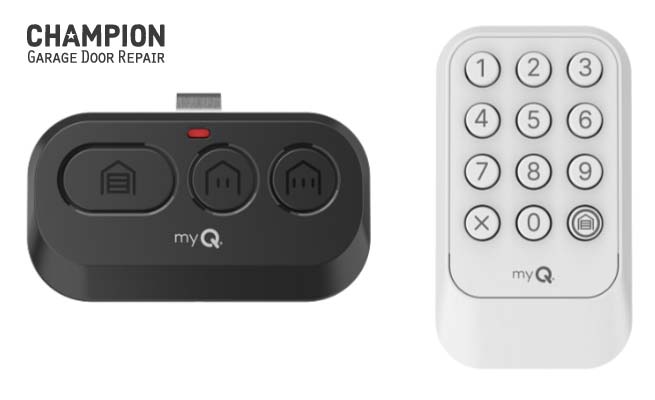
New remotes and keypads have been redesigned and are rated for a range of up to 300 feet under ideal conditions. Battery life is estimated at up to three years with typical residential use.
Programming and Pairing Changes
New Pairing Procedure
Programming Security+ 3.0 devices requires a multi-step, time-sensitive process:
- Press and release the remote button six times within four seconds
- Press the opener’s Learn button
- Press and release the remote button twice
- After door movement, press the remote once more to confirm pairing
This process replaces the simpler programming steps used in earlier generations.
The shorter programming window is designed to limit unintended pairing during the programming. In earlier systems, longer pairing windows sometimes led to crosstalk, where a nearby remote could be programmed accidentally.
Clearing the Opener Memory
Security+ 3.0 openers introduce a new reset process for clearing the opener codes:
- First hold (6 seconds): clears remotes and keypads
- Second hold: clears wall controls and MyQ-connected devices
- Third hold: performs a full factory reset
The revised process allows more granular resets but adds complexity for homeowners and service technicians.
Force Adjustments
New openers automatically recalibrate force and travel limits during operation. This feature is intended to adapt to environmental changes and reduce errors over time.
Early Installer Feedback
Security+ 3.0 is still new to the market, but garage door professionals are already comparing it to earlier Chamberlain transitions and noting concerns based on early installations and hands-on service experience:
- Reduced compatibility with in-vehicle HomeLink systems
- Limited compatibility with third-party smart home platforms
- Increased programming time during service visits
Early service reports indicate inconsistent compatibility with HomeLink versions 5, 6, and 7, despite manufacturer statements suggesting Security+ 3.0 compatibility. At this stage, it remains unclear whether future firmware updates, hardware revisions, or accessory changes will resolve these issues.
New LiftMaster Models Using Security+ 3.0
Confirmed upcoming models include:
- LiftMaster 2100L
- LiftMaster 2220L (integrated camera)
- LiftMaster 2300L (DC motor with battery backup)
- LiftMaster 2420L (DC motor, camera, and battery backup)
These models signal a continued shift toward higher-feature residential systems.
Potential Considerations Based on Past Opener Transitions
Previous technology changes in wall-mounted garage door openers, including models like the LiftMaster 98022 and Chamberlain RJ101, introduced sensitivity and force-related issues that affected door travel and closing reliability in some installations.
While Security+ 3.0 uses a different architecture, installers are watching closely to see how automatic force calibration and Bluetooth-based pairing perform across a wide range of door models and real-world environments. At this stage, long-term performance data is still limited.
Pricing and Market Impact
As older opener models are phased out, more budget-oriented units are expected to leave the market. Industry professionals anticipate:
- Higher equipment costs
- Increased replacement part pricing
- Potential longer service times due to programming complexity requirements
This shift mirrors broader trends toward closed, feature-heavy systems across home technology sectors.
What Homeowners Should Consider and Expect
Security+ 3.0 introduces meaningful changes to how Chamberlain and LiftMaster openers operate, but those changes may not benefit every household.
Before upgrading, homeowners should consider:
- Compatibility with existing vehicles, remotes, and accessories
- Long-term service and repair costs as older systems are phased out
- Increased programming complexity during future service visits
- Availability of technicians familiar with Security+ 3.0 systems
As new models enter wider distribution, Chamberlain and LiftMaster have begun phasing out several entry-level and mid-range opener models that previously offered broader compatibility and simpler setup.
Final Takeaway
For many homeowners, existing Security+ 2.0 openers remain a practical option, especially when compatibility with vehicles, remotes, and accessories is a priority and the current system is operating properly.
Chamberlain and LiftMaster appear to be moving away from the simplicity and backward compatibility that once made them a preferred choice among garage door repair professionals. While Security+ 3.0 introduces updated connectivity and security features, it also brings trade-offs that homeowners and installers should weigh carefully before purchasing.
The Blackstone Group acquired a majority stake in the Chamberlain Group in 2021. Since then, the brand has steadily shifted toward more complex feature-driven products with tighter ecosystem control, a direction reflected in the design, compatibility, and programming changes seen in Security+ 3.0.


I am having trouble finding someone in SW Louisiana to change my codes. one of 2 remotes was stolen by one of my 2 adult children recently. My 41 year old daughter came in & threw clicker in my purse in front of me. I checked found other clicker gone. I arranged to have door locks changed, but it took several weeks. They had keys & things were going missing. Garage gives access to shop of tools, & flimsy back door which is 1/2 glass. so now my door opens at times and I need to change the code to be safe from two (!!) adult children!!!
Hello, see the instructions here on how to change your garage door codes.
Being in the IT industry for many major OEM’s for 40ish years Im absolutely amazed that people blindly gravitate towards ‘cloud’ (which I’ll argue is NOT a destination, rather an operating model) somewhere unknown. THis can easily be built locally – however that give the consumer too much control, and is not in the interest of the OEM.
Look at the past behavior of Chamberlain, they at one point had a public API that allowed people to integrate MyQ with 3rd party apps, but that NOT good for internal revenue generation and they shut it down (almost immediately after a new CIO was appointed, and that guy came from a know consumer unfriendly industry, the cable TV company Tivo). Nonetheless workarounds were developed (a really eloquent one called “RatGDO”) that brought control back to the consumer.
The new stuff is nothing more than an attempt to ‘lock in’ additional revenues, once the consumer starts using these things I expect a monthly fee to be introduced to use anything other than the button on the wall!