



Champion Garage Door Repair Orange County, CA
We provide same-day garage door repair in Orange County. If your garage door is stuck, noisy, or not responding, our technicians arrive fully equipped to troubleshoot the issue and complete the repair on-site. We service springs, cables, openers, and off-track doors, delivering guaranteed and cost-effective repairs with upfront pricing.
Garage door problems in Orange County vary based on environmental factors, usage frequency, and door type. Our process begins with an on-site evaluation of your garage door’s overall condition, balance, alignment, and how it interacts with its components. This approach allows us to recommend the most effective repair or replacement based on system condition and cost.
Emergency Garage Door Services
Champion Garage Door has experienced technicians on call to handle your urgent garage door emergencies. We offer a full range of emergency garage door services in Orange County, including repairs for doors that won’t open or close, broken cables, springs, electric openers, and more.
Unexpected garage door breakdowns in Orange County can leave your vehicles inaccessible and compromise the safety and security of your home and family. We offer 24-hour emergency garage door repair and respond quickly when your garage door malfunctions. Our technicians travel to your location equipped to complete urgent repairs the same day.
Garage Door Spring and Opener Repair and Replacement
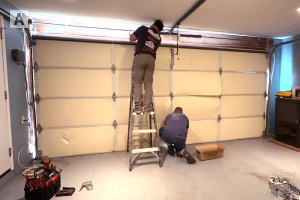
We offer a full line of garage door springs and openers to fit any application, including standard, heavy-duty, and custom systems. We evaluate your system on-site to determine the best solution based on condition and performance. Our technicians provide practical recommendations and are equipped to replace worn components or recalibrate the system when it requires balancing or adjustment, the same visit.
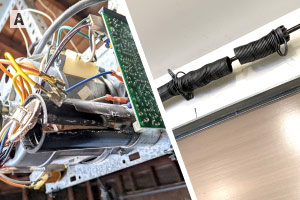
We use certified, galvanized garage door springs for improved durability in Orange County’s climate, and openers that comply with UL and California SB-969 regulations. Our technicians handle torsion and extension systems, replace broken springs, upgrade or retrofit equipment, install new openers, and repair or replace chain, belt, and wall-mounted openers, rails, remote controls, backup batteries, and safety sensors.
Orange County Garage Doors
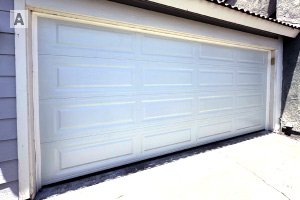
Shop our full range of garage doors in Orange County, including affordable steel, insulated, aluminum full-view, carriage house, wood, and custom garage doors. We offer multiple layouts, colors, specialized finishes, window designs, privacy glass, weatherstripping, insulation R-values, wind-load hardware, marine grade materials, and powder-coated options designed for durable performance in Orange County.
Our garage door installation service includes inspection of your garage, guidance and support, assistance with HOA approval when required, and an upfront, written, detailed estimate with full project specifications. Installation is completed by our certified and experienced installers to meet industry standards and manufacturer specifications.
Timely Garage Door Maintenance in Orange County
Orange County experiences varying environmental conditions shaped by coastal exposure, inland heat, and regional microclimates. Garage doors in coastal areas are affected by salt air and moisture, while systems in inland areas are exposed to dust, heat, and temperature fluctuations.
In coastal environments, corrosion can affect exposed garage door hardware such as springs, cables, hinges, and electrical connections, leading to rust accumulation, increased friction, or component failure. Inland overhead door systems are more likely to experience wear from heat expansion and material fatigue, which can affect balance, alignment, and overall performance.
If your garage door becomes difficult to open or close, has jerky movement, or makes unusual grinding or snapping sounds, it’s time to call a professional. Visible issues such as frayed cables, loose hardware, or gaps when the door is closed also indicate the system needs service. These conditions can worsen quickly and should be inspected before they lead to sudden failure or further damage.
Request a Quote
Serving the Entire Orange County Metro Area
Champion Garage Door Repair provides professional garage door repair and installation in Orange County and surrounding areas.
Frequently Asked Questions
Do you provide emergency garage door service in Orange County?
Emergency garage door service is available across Orange County when a door cannot be operated safely or secured. Emergency requests are evaluated based on system behavior, safety concerns, and access conditions to determine appropriate next steps.
How quickly can emergency garage door service be scheduled?
Some emergency service requests across Orange County can often be responded to within about 60 minutes, depending on location, system condition, and current scheduling availability. Same-day service may be possible when safety concerns are present, though response times can vary based on demand and access conditions.
Why do garage door systems behave differently across Orange County?
Garage door systems across Orange County operate under a wide range of conditions. Differences in door weight, usage patterns, garage layout, and environmental exposure all influence how a system moves and responds over time. As a result, two doors that look similar can behave very differently depending on where and how they are used.
Why does a garage door feel smooth in one home but inconsistent in another?
Movement consistency is influenced by how evenly weight is carried, how components interact during travel, and how frequently the door cycles. Variations in alignment, balance, and friction can develop differently across properties, which affects how predictable the door feels during operation.
Does the garage door opener usually cause movement problems?
In many cases, opener behavior reflects overall system condition rather than causing the issue directly. When balance, alignment, or resistance changes, the opener may adjust how it applies force to maintain motion. Evaluation focuses on the full system to understand what the opener is responding to.
Why can the same adjustment work in one property but not another?
Some systems respond well to adjustment because wear is localized and overall movement remains stable. Other systems have accumulated changes that limit how effective adjustments can be. Across Orange County, outcomes vary based on system condition rather than a fixed rule.
How do technicians decide what to evaluate first?
Technicians prioritize evaluation based on observed behavior during operation. Movement, balance, sound, and consistency guide where attention is focused first. Because conditions vary widely across the region, inspection order adapts to what the system is doing rather than following a preset checklist.
When does replacement become a more practical outcome?
Replacement is considered when repeated corrections no longer produce consistent or predictable movement. This varies by system and property. In those situations, installation is treated as the functional conclusion of replacement rather than a separate service decision.


